
Little things add up!
If you want a truly energy saving household, you need to go beyond swapping a few incandescent bulbs with compact fluorescent lights. Appliances use a big share of your household energy budget, and sometimes a single appliance upgrade can go farther than replacing a dozen light bulbs!
Further down, I provide the mile-high overview on saving energy with your household appliances. But first, here’s a list of the other pages in this section:
- Energy saving washers: save water and electricity, with an old or a new one.
- Energy efficient dryers. Real savings come from rethinking the laundry process.
- Gas vs electric dryers: learn the money and energy issues.
- Dryer balls: do they work? Or are their claims of 25% savings a scam?
- Energy efficient washer and dryer: which one you upgrade makes a difference.
- Energy efficient dehumidifiers work best if you tackle the humidity first.
- Energy efficient dishwashers use less water and energy than hand-washing.
- Energy saving refrigerators: improving efficiency, replacing, changing routine.
- ENERGY STAR refrigerators: what does the rating mean? Should you upgrade?
- Energy efficient freezers: freezer tips, habits, and upgrades.
- Home energy saving devices. Tools that measure energy use, or help you save.
- Energy saving induction cooking: the best way to cook!
- Energy efficient toasters: do you really toast enough to worry about this?
- Best convection toaster oven: it may be all you need for baking and roasting.
- Energy saving kettles: for my fellow tea drinkers, how to use efficiently
OK. Now for the mile high overview:
Start with the major energy hogs
One of the first things to tackle in an energy saving household is the home appliances that use the most energy. Here’s a sorted list showing major appliances and their energy use, based on new models shipped in Canada in 2005:
- Clothes dryer: 903 kWh/year
- Stove range: 564 kWh/year
- Refrigerator : 469 kWh/year
- Clothes washer: 444 kWh/year
- Dishwasher: 396 kWh/year
- Freezer: 386 kWh/year
These figures might not reflect a global average, but they do give an interesting picture: if you’re striving for an energy saving household, it seems like clothes drying might be a good place to start!
When we redid our kitchen we made sure we had an induction cooktop, which is more efficient than either a gas or traditional electric range, and a convection oven.
Refrigerators and freezers have become far more energy efficient in the past ten years, so if you have an old fridge or freezer it probably uses more than what’s shown above.
The efficiency of dryers, on the other hand, has barely budged since 1994. The main improvements have been in moisture sensors that allow the dryer to turn off as soon as the clothes have reached the desired dryness level.
Look for ENERGY STAR and Energy Guide labels
When you’re buying a new appliance, favor models with the highest energy efficiency ratings. In the US and Canada, this means buying ENERGY STAR labeled appliances. But even with ENERGY STAR appliances, you should still look for ones that will cost you the least amount of energy to operate.
EnergyGuide labels on in-store appliances are critical here. First, never buy an appliance if the salesperson says the label is lost, they’re hiding something! Here are some sample labels, one for a very efficient ENERGY STAR labeled product, one for a fairly inefficient product that isn’t ENERGY STAR:
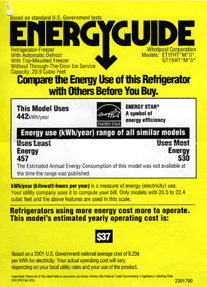
Energy Guide label for refrigerator |
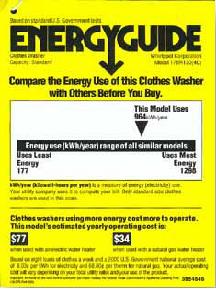
Energy Guide label for clothes washer |
These labels show the range of energy use (numbers below and on either end of the bar) for all appliances in their class, such as fridges of a given size. The triangle on the right label shows how this washer scores against its peers. It doesn’t score that well, considering the lowest washer in the list uses 177 kWh/year and this one uses 964! No place for this one in an energy saving household!
There is no arrow in the left image, because this refrigerator is so efficient it actually scores lower than the lowest other model in its range. So it’s not surprising to see that it has an ENERGY STAR logo (the square above the range bar).
Read the fine print on several Energy Guide tags before you buy. Make sure you understand how the units are being compared. Be aware, for example, that assumptions are built into these labels and the ENERGY STAR ratings.
For example, for a given appliance, the ratings make assumptions about how often you do laundry, how often you do laundry in hot water vs. cold, and so on. Use the labels to help you decide, but be your own judge. If you use a particular appliance much more than normal, pay much closer attention to the operating efficiency.
And work on the little things too
An energy saving household goes beyond the big ticket items like upgrading your appliances, or tackling big areas like home temperature control through better insulation and sealing, or furnace / air conditioner upgrades.
Subtle changes to how and what you cook can save you pennies a day. How you keep your food cool or cold, how you wash dishes, clean your laundry, all of these also have a small impact on their own. Even that blinking 12:00 on the coffee maker is eating away at your hard earned cash, a watt or two per appliance.
Most of these don’t amount to a whole hill of beans, on their own. But the beans, one by one, add up to a pretty big hill. And when you make a series of small changes, that whole hill of beans can wind up saving you big bucks!
And that’s the key to an energy saving household: a penny here, a nickle there, and huge savings when all’s said and done.
That’s why, for example, in my energy saving household, we unplug the coffee maker when it’s not brewing (how many clocks do you really need!?), and we unplug the TV when we’re not watching it. It’s why we measure before we boil water for tea or pasta; we don’t boil more than we need.
Little changes like these have added up for us, to the point where we use half the natural gas and a third the electricity of similar households in our neighborhood.
Replacing an old fridge with an energy efficient refrigerator is probably the biggest improvement you can make in household energy use. (Shutting down that basement beer fridge is a great idea too.) But adjusting your fridge thermostat accurately and correctly can make a big difference too.
The same applies to a freezer in an energy saving household: there’s a big gap between the electrical consumption of a 10- or 20-year-old freezer left to its own devices, and that of a recent-model energy efficient freezer, especially when you follow my many freezer tips.
Other household efficiency tips
To save energy on cooking, you can go from the radical (not cooking) to the obvious (not opening the oven door 20 times to check on those cookies). For a look at the future, consider energy saving induction cooking, an alternative popular in Europe and Asia and just catching on here. It provides the control of natural gas cooking, with better safety and efficiency than either gas or traditional electric cooking.
There’s laundry — a tiny energy user in our home, but a big waster for those who do laundry the energy-intensive way. Again, how about a radical idea for a change: don’t wash your clothes! Okay, maybe not that radical, but do you really need to wash every piece of clothing after it’s been worn once?
Or, to paraphrase that great Canadian prime minister and occultist Mackenzie King: wash clothes when necessary, but don’t necessarily wash clothes! I provide loads of tips to save you money on laundry, from how to select energy saving washers and energy efficient dryers, to techniques for not using them that often.
Then there’s that grab bag of miscellaneous household appliances that use energy. What are energy efficient dehumidifiers? Ones you barely ever need to use! You’d be surprised how much energy some of your home appliances and home electronics consume when you thought they weren’t doing anything!
At the same time, beware of energy saving household appliances that don’t really make a difference. For example, a toaster draws lots of power when on, but it’s typically only used a few minutes a day, so an energy efficient toaster that uses 30% less energy might sound smart, but has a payback period of decades!
Leave a Reply
Want to join the discussion?Feel free to contribute!