
Cook in style and save energy too
When I wrote about energy saving induction cooking fifteen years ago, the technology was well advanced in Asia and Europe, but barely known in North America. Now induction cooktops are increasingly popular everywhere, and high quality induction ranges are competing with the best electric and gas ranges. And since we have now been cooking with a 36″ induction cooktop in our own kitchen for over a decade, I can now offer some of my own personal observations. In a word – we LOVE it!
Induction cooking technology has been around for a long time, and is both more energy efficient and easier to work with than electrical resistance cooking, which is what most electric stovetops use. But perhaps because old habits, or old electric stoves, die hard, few people even consider an electric induction stove when appliance shopping. Why would they, when they’ve never even heard of one?
First, what is energy saving induction cooking? Basically, induction cooking involves an electric current circulating through a coiled wire underneath a glass plate; this electric current creates an electromagnetic field that in turn causes a metallic pot or pan placed above it to heat up, so that the contents of the pot or pan cook. Advantages of induction cooking include the fact that the pot starts to heat instantly when current is applied; the pot stops heating instantly (and any boiling within also stops instantly) when the element is turned off; and 100% of the energy in the induction coils goes towards heating the pot, whereas on a typical electric or gas stove, a large percentage of the heat escapes into the ambient air.
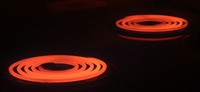
These aren’t nearly as efficient…
Second, here’s something that energy saving induction cooking is not. If you’ve seen a stove range with a glass top, and circles of coils underneath the glass plate that light up when turned on, these are not induction stoves. They are radiant heat stoves. Like a radiant space heater, a radiant stove element consists of an electrically resistant element that emits infrared radiation, which is converted to heat when it strikes an object, in this case the pot above the glass. Radiant stoves are gaining ground in North America but not because they are particularly energy efficient or fast to warm up. They have close to the same energy efficiency as a regular electrical resistance stove, but they are popular because of the flat glass surface, which makes cleaning up spills easy – after cooking has stopped and the hot glass has cooled down, which can take a long time!
My first exposure to energy saving induction cooking was in a Chinese restaurant in Toronto. Each patron at a table has their own induction element, covered by a glass table top. There’s a knob to control the element, on the edge of the table. A server brings you a steel bowl filled with a hot broth of your choice. At the buffet you select your protein, vegetables, and seasonings, and bring them back to your table. On goes the induction burner – and within a few seconds the broth is boiling cheerfully, cooking your lunch. You can touch the table top – even within a half inch of where the bowl of bubbling soup touches the table – and not feel any heat. And if the boiling gets out of control, you turn down the burner and the water stops boiling immediately.
Advantages of energy saving induction cooking
The main advantages of energy saving induction cooking are:
- Energy savings, especially when rising fossil gas prices are considered
- Improved safety over both electrical resistance and fossil gas cooking
- Ease of cleaning
- Instant heat, instant adjustment of heat, and instant off
- Constant heat level
- Lowest carbon footprint of any type of cooking
Advantage #1: Energy savings
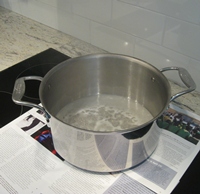
Induction stovetop with boiling water
Photo © Green Energy Efficient Homes
Obviously, the first advantage of energy saving induction cooking is that you save energy! As mentioned above, none of the heat is wasted flowing up from the burner around the outside of the pot. The pot itself is your heating element, with the coils beneath only serving to convert the electrical energy of the stove into heat energy in the pot. In terms of the share of input energy available to do actual cooking – whether with electricity or gas – energy efficient induction cooking is the hands-down winner, with up to 90% of the electric energy being converted to heat inside the cooking vessel. For fossil gas, up to 60% of the cooking heat is lost to heating your stovetop or the kitchen air, so fossil gas efficiency can be as low as 40% efficient. For electrical resistance cooking, up to 45% is lost to escaping heat, so electrical resistance heating peaks at around 55%.
It may be hard to believe that an electric cooking process can approach the efficiency of fossil gas – especially when, for fossil-fuel-fired electricity, at most 45% of the original heat produced from burning the coal or fossil gas gets converted into electricity. But if 90% of the electricity delivered to the stove gets turned into heat with an energy saving induction cooktop, the overall efficiency is (45% x 90%) or 40% overall efficiency – thus competitive with fossil gas from a total energy footprint perspective (assuming the electricity came from a fossil-fuel-fired power plant). At practically the same total efficiency as fossil gas cooking, energy saving induction cooking (even factoring in the power plant energy losses) lives up to its name.
Advantage #2: Improved safety
Energy saving induction cooking devices are safer than fossil gas while being just as responsive to your need to raise or lower the heat. They are safer than fossil gas stoves because there is no open flame, so hot oils and fats splashed on the surface will not catch fire, and because there is no risk of explosion due to a fossil gas leak (for instance, a gas stove element turned on but not lit). They are safer than either fossil gas or electrical resistance cooking because the stovetop surface does not get hot, so you are much less likely to burn yourself. They are also safer than electrical resistance cooking because boil-over situations are instantly brought under control by lowering the burner temperature. And although induction cooktops look very similar to ceramic cooktops, the quick rise and drop-off in burner temperature when the burner is switched on or off, and the generally cool surface of an energy saving induction cooktop, don’t apply to the ceramic cooktop, which heats slowly and takes forever to cool down.
Advantage #3: Improved cleaning
Induction cooking stovetops have a single glass plate you can wipe clean as soon as all pots are removed. You can also wipe up spills around pots as food is cooking, as long as you are careful not to touch any hot pots with your hand. You can even move a pot away from an active element, wipe that area down, and return the pot to that element to have it instantly resume cooking. Food does not cook onto the glass plate because its surface never becomes hot enough to bind the food to the glass. Compare this to a fossil gas burner where spills get under the flame and instantly cook or even carbonize on the enamel surface or on the metallic frames that hold pots above the burner. Compare it also to an electric stove where foods can spill into the basin beneath the burner and either cook on, or carbonize, and then smolder or catch fire the next time the element is turned to high. In fact, the glass cooktop of an induction range or drop-in induction cooktop is easier to clean than the glass cooktop of a radiant electric range or drop-in radiant cooktop, because unlike the radiant cooktop, where the coils heating the pot also heat up the glass, induction cooktops stay relatively cool. The only heat you have to watch out for is the heat from the pot spreading down into the glass – and if the pot contains water, the glass itself even directly under the pot should never be beyond the temperature of boiling water.On an induction cooktop or range, you can even make cleaning easier – if you anticipate a lot of bubbling and spills of staining liquids – by placing a sheet of newspaper over the glass before you start cooking. The newspaper will not burn, and once you’re done cooking, you can remove it and compost it (don’t put it in the recycling!) and not have any mess to clean up.
Two caveats on the cleaning for induction cooktops: aluminum foil, and glass breakage.
- If you drop aluminum foil on the stovetop when an induction burner is on, the aluminum will bond to the stovetop and become very difficult to peel off even after power is cut. Keep aluminum foil well away from an induction stovetop at all times.
- If you drop a heavy or full pot or other heavy or hard object on the glass cooktop, there is the risk of breaking the glass. The cost of replacing the glass can be quite steep. A look at the number of dents and scratches in the top of your conventional range should tell you how big a risk this is.
Advantage #4: Instant heat, instant adjustment of heat, and instant off
As when you cook with fossil gas, energy saving induction cooking lets you instantly regulate the temperature, from turning a burner on and instantly having the induction ready cookware begin to warm, to lowering or raising the temperature and having the cookware respond immediately to the change. On traditional electric ranges, when a hot pot is pulled off a hot burner (for instance when a pot of pasta is cooked and ready to drain), the remaining heat in the burner is wasted, unless you have the foresight to turn the burner off a minute or so before the cooking is done. On an induction cooktop all the heat was in the induction ready cookware from the start, so none is wasted.
The instant heat feature of induction cooktops is one of their greatest advantages. We can boil a pot of water for tea in about three minutes on our induction cooktop. It’s actually faster than an electric kettle. On our old electric range it would take at least twice that long.
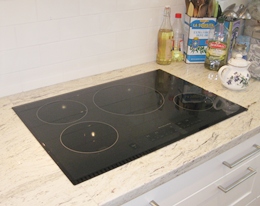
Our induction cooking stovetop
Photo © Green Energy Efficient Homes
Advantage #5: Constant heat
Electrical resistance cooking provides relatively constant heat but because the heat is concentrated in the coils, which only touch a spiral area of the bottom of a pot, they can cause uneven cooking, particularly when you are simmering a sauce or slowly melting a solid such as butter or chocolate. (Just look at those spiral burn marks on the bottom of a pot after you leave a white sauce unattended, and you’ll understand.) And while the current going to an electrical resistance coil stays fairly constant if you don’t touch the dial, there can be wide variations in temperature depending on the quality and design of the element. Energy saving induction cooktops let you set the wattage at which a burner operates very precisely, and that produces a consistent heat level throughout the cooking processes. You can simmer a white sauce, for example, for a long time without burning it.
Of course, there are limitations to any heating element: a constant temperature applied to a food can cause evaporation, and eventually that constant temperature can lead to burning as less and less water remains in the pot.
Advantage #6: Lowest carbon footprint of any cooking appliance
Some would argue that because a fossil gas stove uses the heat from fossil gas directly, it has a lower carbon footprint than an electric stove powered by a fossil gas plant, with typical peak efficiencies of 45% at converting the heat to electricity. But remember, that fossil gas stove is only around 40% efficient in terms of the percentage of the heat in the fossil gas that makes it into the pot. And very few areas are still served 100% by fossil fuels. In areas with a large percentage of carbon-free electricity, an induction cooktop, with its low electricity consumption, will have a far lower carbon footprint than a fossil gas stove, and a somewhat lower carbon footprint than a resistance electric stove.
Drawbacks of energy saving induction cooking
Although there are definite advantages to energy saving induction cooking, it has some disadvantages and limitations too. The first and foremost is that the stovetop technology is quite expensive. As well, only cooking vessels made of ferrous metal (steel or cast iron) will work with energy saving induction cooking. Then there’s the question of kitchen layout, as until recently most of these units have been cooktops, although fortunately induction ranges are starting to appear on the market. Let’s explore each disadvantage of energy saving induction cooking in detail.
Disadvantage #1: High up-front cost of energy saving induction cooking
While energy saving induction cooktops are popular in Asia and Europe, and are gaining some ground in the US and Canada in professional kitchens, new condo kitchens, and kitchen remodels (like the one we did in 2010), these cooktops have not fully caught on in the North American residential market, for a number of reasons. Induction cooktops are more expensive than a mid-priced electric stove/oven range, in part because of the increased complexity of the components, and in part because there is less demand or competition for them. But prices are definitely falling. When I wrote this article in 2009, there were dozens of manufacturers and wholesalers (brands) of traditional ranges, but just over a handful of induction cooktop manufacturers who sold to the North American market (brands such as GE Profile, Hitachi, Jenn-Air, KitchenAid, Panasonic, Thermador, Viking, and Wolf). Prices back then ranged $1,500 to $3,000 for a residential unit, and few appliance retailers even had models available to demo I visited 3 major appliance retailers looking for induction cooktops. The local Sears appliance store had no floor models and one model in their catalog; a nearby appliance big box store had one lonely floor model and sales help that knew nothing about it. Tasco Appliances was the one retailer we found in the GTA that had a great selection of induction cooktops at reasonable prices, and sales people who knew something about them.
But in 2023 prices are substantially lower and there is much broader availability. Even just searching Amazon for energy saving induction cooktops, I find dozens of full cooktops – ones with four burners – in the $900-1,200 range. I would still probably recommend going with one of the high-end name brands above, but if you are mainly concerned about your budget, you may still be better off going with a lower-cost model than sticking with your existing stove. Some key reasons you might want to upgrade to an induction stove, regardless of your financial situation:
- You use your current stovetop very frequently, with multiple burners are on several hours each day. For instance, you may run a bed and breakfast or catering business from your home, or like me, enjoy serving four course meals to your guests.
- You want to save energy and you want to enjoy the ease-of-use and ther benefits of energy saving induction cooking, even if the total cost of ownership is higher than a traditional electric stove.
- You are very focused on cutting energy and other costs, and are prepared to pay more to save more regardless of financial payback.
Let’s look at the first two scenarios in more detail, and then the third scenario separately.
Cost is not an object, or you cook all the time: Even If you cook a lot of fancy dishes and are typically using the cooktop several times a day, and using several burners for each meal, the payback period for an energy saving induction cooking stovetop is high, because we just don’t use that much energy while cooking. For an average user you’d need to pass the unit onto your children or grandchildren before the energy savings pay for the extra cost. This is a good example of the importance of doing payback analysis (also known as ‘Energy return on investment’). Consider these scenarios:
| Usage type | Typical | Heavy | Semi-professional |
| Burner minutes per day (equivalent to high power) | 15 | 45 | 180 |
| kWh / day usage (electrical resistance cooking) | 0.25 | 0.75 | 3 |
| Cost / day | $0.05 | $0.17 | $0.69 |
| 50% savings per day for induction | $0.03 | $0.09 | $0.35 |
| Additional cost of unit | $500 | $500 | $500 |
| Years to reach payback | 48 | 16 | 4 |
In this payback calculation I assumed:
- A typical user cooks one meal a day on the stove; a heavy user cooks several meals or at least one meal with several stovetop-cooked dishes; and a semi-professional user is cooking for a small catering operation or other small food-related business.
- The ‘burner minutes per day’ is a ballpark estimate of how much heat is generated, equivalent to one small 1 kilowatt burner on full. So 15 minutes per day could mean having a small burner on 15 minutes on full (to hard-boil a few eggs), or a pot on simmer for an hour, or perhaps the energy to cook a half-dozen grilled cheese sandwiches and some scrambled eggs.
- The savings per day is based on the fact that half of the original energy estimated would not be used, since energy saving induction cooking is 50% more efficient than electrical resistance cooking.
- The induction unit costs $1,500 and a standard range costs $1,000, so the additional cost is $500.
- The payback period refers to the point at which the energy savings from energy efficient induction cooking have paid for the additional cost of the induction unit.
- Cost of capital (that is, lost income from not investing that $500 in something that pays dividends or increases in value) is not included in the payback analysis. Whenever you factor in cost of capital, payback periods tend to stretch out longer, because the biggest part of the expense (purchasing the unit) is incurred early, while the savings accrue over a long period.
- Potential increases in energy costs, or time of use charges, are not included. Time of use charges alone would significantly change the payback, as most people tend to cook in the early evening during the week, which is often a time of peak energy usage and high time of use prices. Even so, even if you’re paying $1.00 or more per kilowatt hour during peak times you’re still looking at a 10 year payback for typical use, or a 4 year payback for heavy use.
As you can see, in the semi-professional case, it takes only 4 years for the additional cost to translate into money savings, and the faster heating of an induction cooktop (even compared to a fossil gas range) will also make you more efficient in your kitchen. But for more moderate users, you can’t justify such a purchase on economic grounds alone.
Bear in mind, of course, words of wisdom from an electrical engineer I know who works in the energy efficiency industry: most payback analyses overestimate costs, and underestimate both achievable savings and future energy costs. So the payback periods above are probably overly conservative.
If simple living and savings are your object: There are energy saving induction cooking elements available for sale individually, often for as low as $50 US. These units plug into your wall and are handy for a one-or-two person household without a stove. (How many times do people use all four elements on a regular range, even when cooking a meal for a whole family?) Assuming a moderate user bought one such unit, and a heavy user bought two, at $50 or $100 total cost respectively, then the payback period for the moderate and heavy users would become 5 years, and 3 years, respectively. These payback periods make the individual element option a viable way to cut your electricity costs, and also get a feel for energy saving induction cooking before you take the plunge and buy a full cooktop unit.
Bottom line? If you’re a heavy user, it might be worth your while financially to upgrade from a mid-range traditional electric stove to an energy saving induction cooking stovetop. If you’re a casual cook and don’t need a fancy range, one or two individual elements bought online or from an Asian supermarket might be a good investment.
Otherwise, you’ll need to have another rationale, such as ease of use and improved control. Judging from the reviews of induction cooking you can find all over the web, most users of induction stovetops (professional and amateur chefs alike) love these units and can’t sing their praises loud enough. From my perspective as a frequent user of our induction cooktop over the past 13 years, I can’t imagine cooking on anything else, and anytime I stay over with friends or family who have a gas or electric stove, I find myself frustrated by the slow heating, the slow change in temperature when I adjust the knob, and the fact that the stove gets uncomfortably (even dangerously) hot not just on the burner but around it.
Disadvantage #2: Only ferrous metal pots work with induction cooktops
Because energy saving induction cooking uses an electromagnetic field inside the element to transfer energy to a ferrous (iron or steel) cooking vessel, which vessel acts as the electrical resistance cooking element, you will not be able to use any old pots you may own that are not made of ferrous metal. This means that anything made of copper, aluminum, ceramics or glass will not respond to your attempts to cook with it – the burner will activate when you turn it on, but nothing will heat up. (Our cooktop actually makes unpleasant clicking noises when you use an incompatible pot with it.)
This also means you need to be careful when purchasing new cookware. If the label does not state that the contents are induction ready cookware, you can test the cookware for suitability with a strong magnet. Bring a fridge magnet to the store with you and make sure the magnet bonds to the bottom of the pot; if it doesn’t, you will not be able to use that pot with energy saving induction cooking. Even some cookware that claims to be compatible with induction cooking may not be, so make sure you do the test (or save your receipt to get a refund if the claims prove incorrect).
Induction cooktop manufacturers have realized that induction ready cookware is a big up-front expense, and that people’s need to replace much of their existing cookware discourages many people from trying out induction cooking. For this reason many induction cooktop brands such as Miele cooktops, Frigidaire cooktops, Wolf cooktops and others offer fairly frequent specials on their cooktops, with a free set of high-end induction ready cookware thrown in when you purchase one of their cooktops (or when you purchase a cooktop and one more appliance from their brand.)
Disadvantage #3: Full cooking range configurations are still unproven
You may have noticed that in this article where I tend to use the term energy saving induction cooking, I’ve kept away from the term range. That’s because cooking ranges – appliances that include a stovetop and an oven, such as one typically finds for an electrical resistance or fossil gas stove – are less common than induction cooktops, for technical reasons.
An energy saving induction cooktop (or individual unit) uses a device called a generator for each heating element, in order to generate the electromagnetic field that heats the ferrous cooking vessel. These generators are both bulky and heat-sensitive; if they get too warm, their efficiency drops, and finally they simply stop working. As a result, it is technically challenging to build a full stove range with induction elements, because the extra space required for the generators would result in a lower or smaller oven, and heat from the oven cooking could prevent the induction burners from working at all when the oven is in operation.
As a result, most induction units are sold as induction cooktops, which can be dropped into an open space in a counter during a kitchen build or remodel; the oven normally goes somewhere else in the cabinets, not directly under the induction cooktop. This configuration doesn’t mean you need extra space, just that you can’t have the oven under the induction cooktop.
When I wrote this article in late 2008, I mentioned that you could not just replace your current electrical resistance or gas range with an energy saving induction cooking range, because they didn’t exist! Well, a number of appliance manufacturers have since worked to overcome the technical challenges of keeping oven heat away from the induction generators, and there are now a number of induction ranges available. While the look of a drop-in induction cooktop is more aesthetically pleasing than a range, if you already have a slot for a range in your kitchen, replacing your old electric or gas range with an induction range may be the best opion.
The bottom line on energy saving induction cooking
The bottom line is, if you are redoing your kitchen and want the most energy efficient, elegant, easy-to-control cooking system, an induction cooktop is definitely the way to go. There is no doubt it will save you energy compared to electrical resistance cooking, and from an energy perspective its efficiency is on a par with fossil gas even when you factor in energy losses at a coal-fired power plant. But you’ll need other motivations to justify the extra cost.
On the other hand, if you are living as cheaply as possible and don’t already own a working electric or fossil gas range, then one or two inexpensive induction burners are a great way to try out energy saving induction cooking technology and get your kitchen up and running for the odd pot of KD or a plate of scrambled eggs.
I do 95% of the cooking and have seriously considered purchasing an induction 2 burner cooktop. I never use more than two burners on our conventional glass cooktop. I can purchase a 2 burner stand alone induction cooktop for around $199. We live in the deep south where it is necessary to use A/C in the summer months (summers get very hot here). The additional heat from our stove top radiated heat for about and hour and adds heat to the house, thus the A/C unit has to compensate for the added heat. I have done everything I can to reduce my energy bill, new E-glass windows, 18 inches of insulation in my attic, new 15 SEER A/C etc. Will this save enough energy to be worth my while? Bill
In my experience (6 years with an induction cooktop) the happiness factor alone makes induction worthwhile. I get incredibly frustrated when I’m trying to cook at someone else’s house and I have to wait for things to heat up. Induction heats up super fast, all of the heat goes into the pot and the food – none is left over on the cooktop or up in the air. I don’t know if the financial savings alone are enough to justify the purchase, but I would say between the reduced heat generation and the increased convenience, you won’t regret getting an induction cooktop.
Never refrain from buying an induction stove… I replaced our gas stove with an induction one in spite of my mother opposing the idea. But now she’s happy that I bought the induction stove.
One factor to consider heating up the area in the summer month, this, in turn, make my air conditioner work harder. I have the infrared smooth cooktop and the biggest drawback is the time it takes to heat a pot of water or bring a pot to simmer. Another is clean up if I get a pot overflow and it burns it is much harder to clean up.
I did order an induction single unit to try for $70 it is only 1900 watts, but many times I use only one or two burners on my current range.
We bought a GE induction stove and really like it except for one annoyance. It seems our LED kitchen lights create a loud hum when cooking. Turn the LED lights off and the hum disappears. Has anyone else noticed this issue? GE has not been helpful.
Do you have your LED lights on a dimmer switch? And if so is that dimmer switch designed for LED lights? Are the LED lights rated as dimmable? That’s the only thing I can think of that might remedy the situation.
I have been researching induction plates before buying, and another site did mention the possible impact on random equipment, including radio reception. I cannot recall offhand if LED lights were specifically mentioned, but it makes sense that most electrical equipment has the potential to pick up interference. However, I did get the impression that this affects the minority of users/equipment, and you might try a long shot and replace the bulbs with ones with a different power rating/consumption, or brand to see if that makes a difference (at the same time it might be worth checking if all the LEDs hum, or just certain ones, then just try replacing those ones. If its just one or two, and the above suggestion does not work, you might want to try halogen globes).