
Upgrades that pay for themselves
I’ve done many home energy saving projects over the years, some trivial, some major. Home energy saving projects can be expensive — retrofitting your entire home with energy saving windows and doors can run to the thousands of dollars.
But the benefits can be huge too — it’s a matter of costing out the upgrade and projecting the savings, to see how long each project will take to pay for itself in energy savings. Here are some topics I cover in my energy saving projects section:
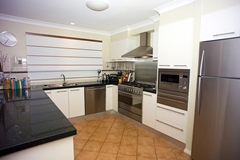
Not only does it save energy, it looks great!
The best energy efficient windows — better even than ENERGY STAR windows — have a high R-value and a long-term warranty, and can cut your energy costs by up to a third.
An energy efficient basement is one with good humidity control, adequate insulation, efficient climate control, and natural light where possible. I dug out my own basement in 2002 (dropping the floor 16 inches) so I have lots of knowledge to share here!
Attic ceiling insulation is a great way to cut your energy bills. Find out how much you need, how to top up existing insulation, and whether to do it yourself or hire a pro.
Icynene insulation pros and cons describes the good and the bad of this professionally applied spray-in insulation, which we had added to our ground floor in 1998 and which continues to keep us toasty warm in winter and cool in summer.
Crawl space heaters are one solution to crawl space humidity or cold floors upstairs from a crawl space. But these problems can also be solved with some simple renovations that won’t commit you to years of higher electrical bills.
Energy saving window coverings can cut down on heat transfer between your house and the out-of-doors, whether in the cold of winter or the heat of summer.
Whether you choose energy saving curtains, blinds, roll-up shades, or a temporary plastic window insulation kit, you can cut your energy losses significantly.
Insulating window blinds are one particular kind of window covering that provides great insulating value as well as a stylish appearance.
You can also buy energy efficient window film, which you cut and spread directly on the glass of your windows to reduce heat transfer in both summer and winter.
Heating duct insulation can cut your heating and cooling bills by up to 35% if your ductwork passes through uninsulated spaces such as attics or crawl spaces.
An Infrared heat gun helps you find the worst thermal leaks in your house, so you can prioritize efficiency upgrades. Every energy saver should own one.
For free lighting, consider a solar light tube, which direct natural daylight from your roof down into a top-floor room, even one that receives no natural light of its own.
Draftproofing a door is one aspect of weatherstripping, and is far cheaper than buying a new front door, while providing most of the same energy saving benefits.
Green roofs help keep your home cooler in summer and warmer in winter, while providing habitat for little critters and a great garden for your family. We installed one in 2012 and it is now thriving.
Start by understanding the savings potential
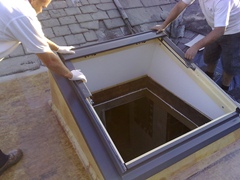
Skylights allow natural sunlight to brighten your home
Photo by tanais, via FLICKR
Any home energy saving project that cuts your energy use has the potential to pay for itself over time. Just pretend you’re taking out a loan to pay for the project, and make sure the loan won’t cost more in interest than you save on energy bills. (If this doesn’t make sense to you, you might want to do a refresher on payback periods or energy return on investment — EROI.)
Energy efficient home improvement starts with an understanding of where your home is energy inefficient. In more and more cities, there are experts who can do a professional home energy audit for you.
They’ll do a detailed assessment of your home and tell you (or better yet, produce a written report) about how efficient your house is, and what kind of savings you might expect from various upgrade options.
This can be money well spent — sometimes the big ticket item isn’t the one with the big ticket savings!
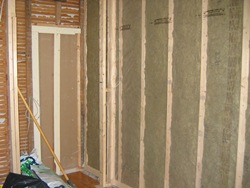
Gutting and reinsulating a bedroom makes a huge difference to comfort and heating costs
© Green Energy Efficient Homes
I highly recommend getting a professionally done audit; if you do, you may even get money back from the government or from your local utilities, for energy upgrades performed after the energy audit.
Unfortunately, most of these energy saving grants don’t cover work done before an audit, and some may require an application before the audit starts.
Of course, if you don’t want to pay for the professional energy audit, you can try doing one yourself — you just have to know what to look for!
The photo at left shows one of the bigger upgrades I’ve done to my house (with help from a contractor): gutted and reinsulated each of our three bedrooms, one at a time. We actually increased wall thickness by 1.5 inches so we could get a full 6″ batt insulation in. The energy savings and improved comfort have been excellent.
Some other home energy saving projects we’ve tackled:
- Injected Icynene foam insulation into my main floor walls. An instant, noticeable increase in winter comfort!
- Replaced all the original windows — and not only saved on energy but got a better looking house both inside and out!
- Sealed all our baseboards and around all window and doorframes, based on the auditor’s suggestions. A big improvement to the air tightness of our home.
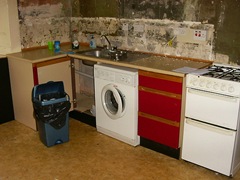
New ENERGY STAR appliances are an essential part of kitchen renos
Smaller projects have ranged from the obvious (like making sure every window has an energy saving window covering) to ones that would never have occurred to me without an energy audit (like levelling the blown-in attic insulation with a leaf rake).
Rooftop gardens, such as the green roof we recently installed on our new addition, are another great energy efficiency upgrade — you literally grow plants on the roof of your house. This saves on heating and cooling costs because of the added insulation the green roof provides — and you don’t need to have a green thumb.
If your idea of a home energy saving project is to build a new home from scratch, that’s great, but choose your design carefully. Many websites offer passive solar designs that balance winter solar heating with summer shade, but their energy efficient floor plans tend to be for oversized homes.
Using less space, I believe, is a smarter starting point for energy efficient homes than using too much space efficiently!
I dont understand how these work. The skylight only brightens the room and dosn’t really heat the building and on the other hand its in the ceiling so you cant even see it because it in the ceiling.
Skylights allow you to see the sky (and surrounding trees/buildings/etc) – they are typically large openings where the ceiling is very close to the roof.
Skytubes consist of a plastic dome at the top, a long tube with a mirrored interior surface, and an opaque opening at the bottom; their purpose is to bring free sunlight into a space that would otherwise need more electric light.
Neither skylights nor skytubes are designed to heat a building (although the room with a skylight in it will get hotter in summer). They are designed to let in light.
New windows are a great help. As the seasons change, double-hung windows provide extra protection from air and moisture penetration, sound and UV rays, thus minimizing fading of furniture and carpet. Double Hung windows provide the utmost in efficiency while reducing annual heating and cooling bills. Reduced energy useage helps to pay for the windows.