
Troubleshoot yourself? Or call a pro
Some home air conditioning problems are easy to solve yourself. If there’s no power to your compressor there may be an easy fix. For other issues, you’re better to hire a qualified technician. After all, it’s not worth saving $100 on a service call with a do-it-yourself home air conditioner repair, only to discover you’ve wrecked the system.
You’ll find the common air conditioning problems I describe below both easy to troubleshoot and often easy to solve.
Remember that, especially for a central air conditioning unit, you should have your system serviced annually by a qualified HVAC technician, and you should use such a technician to resolve any problems where the cause and solution are not both obvious.
- Air conditioner won’t turn on
- Air conditioner cycles on and off frequently (short cycles)
- Air conditioner runs constantly but doesn’t cool well
- Air conditioner runs but doesn’t cool at all
One of the biggest home energy wasters is an air conditioner that isn’t working properly. By helping you diagnose some of the simplest problems – and urging you to go to the pros when there isn’t an easy diagnosis or solution – I can help you save energy and money.
You’ll save energy if your current system works properly. You’ll save money by not ruining a perfectly good system when you try to solve air conditioning problems you’re not qualified to solve.
This bears repeating: Do not try to fix an air conditioner problem if you aren’t sure you understand the cause, or the solution.
Air conditioner won’t turn on
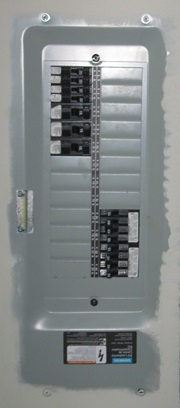
First check this…
© Green Energy Efficient Homes
Let’s look first at problems with central air conditioners, then room units.
Air conditioner won’t turn on – central air
For a central air conditioning system, the key things to look for are problems with power, fan, thermostat, noise, coolant pressure, condensate drainage, and startup time. Also, you may have a PeakSaver or similar energy saving device installed and not realize that it’s working properly!
Power: Most central AC systems are on a separate circuit breaker, often a double switch. Many people flip this circuit breaker off at the start of the heating season, to prevent someone from accidentally starting the AC unit at a time when cooling is never needed. So check that this circuit breaker is turned on.
If it is turned on, turn it off then back on (sometimes the switch has tripped but is close enough to the on position that it seems to be on already). This is one of the most common air conditioning problems according to technicians I’ve spoken to – so check your circuit breaker!
In many jurisdictions, a breaker may be required within a short distance from the outdoor compressor unit. If you still can’t get power to the compressor, check for this circuit breaker either inside your house near where the wiring exits the house, or on the outside of the house near the compressor unit. Try flicking that breaker off and back on as well.
If either the panel breaker or the compressor breaker circuit trips off after you try using the AC again, don’t flip it back on – call a qualified technician. There may be a serious electrical problem that needs to be looked at by a professional.
If you have a combined central AC and forced air furnace system, the circuit that feeds your furnace should also be on, because the furnace fan needs to run to circulate the cooled air. Check this circuit as well, using the same process of turning the breaker off and back on.
The furnace circuit could be controlled both by a circuit breaker on your breaker panel, and possibly by a wall switch in the furnace room. Check both. I have such a wall switch and use tape to keep it in the correct position (on during heating/cooling season, off in spring and fall), to prevent someone from mistaking it for a light switch and accidentally turning it off during the heating/cooling season.
Another thing to check is that the fan is running. If you set the fan setting on your thermostat to “on” instead of “auto”, you should hear the furnace fan start to run even if the air conditioner doesn’t turn on. If the fan doesn’t turn on, this is an indication no current is getting to your furnace.
Try setting the thermostat as low as it can go (remember to turn it back afterwards!). It’s possible that the thermostat controls are not working properly. I once had to turn my AC down to 49F (9C) to get the compressor to kick in! That was clearly the sign of a faulty thermostat.
If your thermostat is a programmable thermostat such as the one pictured at right, check that it shows some indication of being on! If you can’t see anything on the LCD display, there may not be any power getting to the thermostat. This could be because the DC line powering the thermostat is off, or because the furnace is switched off.
Compressor makes no noise: When you run the AC your windows and doors tend to be (and should be!) closed. Make sure your assumption that the compressor is off isn’t just you not hearing the noise through closed doors and windows.
In some central air units, the compressor (outdoor) unit has a high pressure cut out, which stops the unit if the coolant pressure gets too high. The high pressure cut out button sticks out of the cabinet, near the coolant lines. Press this button in to reset it. If the button pops back out soon after the unit starts up, call a technician to have the refrigerant level checked. Don’t keep trying and hope the problem goes away!
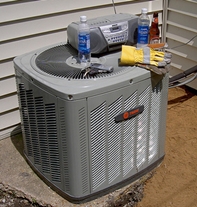
Then get out the gloves…
The evaporator unit in a central air conditioning system needs to drain condensed water that collects on the coils. Two common problems are that the condensate drain may be blocked, or, if the system uses a condensate pump, the pump is not working.
If condensate is not properly draining, check that the condensate drain is clear and that water can flow freely down it, and if the system has a condensate pump check that it is plugged in and working.
PeakSaver: In some areas (such as my home town of Toronto) you can get a modest rebate from your utility if you allow them to install a device called a PeakSaver on your air conditioner. This may be the cause of an air conditioner not turning on.
During a heat wave, when everyone’s AC unit runs at full blast, there are huge spikes in demand that can stretch the electrical grid to the limit. Utilities offer these free devices to homeowners to reduce this stress on the grid. The device periodically reduces power to your compressor during peak demand periods, so that everyone’s air conditioner is not running at the same time.
In most cases this won’t affect your indoor comfort level over the space of a day, but it can be disconcerting when you turn on your AC upon getting home, and it doesn’t kick in for a while. (Typically a PeakSaver will not cycle your air conditioner off for more than 15 minutes.)
Finally, be patient. Sometimes it can take a minute or two for the compressor to start up. If the system routinely takes a long time to start up, have your unit serviced.
If none of these tips solve your home air conditioning problems, call a technician. It’s not worth the risk to your AC unit or your own safety to try tinkering.
If your central air conditioner is showing signs of wear and tear and is more than 10 years old, or has failed repeatedly, you might want to spare yourself the expense of another service call, and instead consider getting a replacement unit. (Most HVAC contractors provide free estimates, but almost none provide free service calls on an existing unit, unless it is covered by an extended warranty or service contract.)
Room air conditioner won’t turn on
Check for obvious causes of this air conditioning problem: is it plugged in? Is the outlet live? Has the selector switch inside the unit tripped?
To check if the outlet is live, plug in a lamp or other device that indicates power. Remember that a room air conditioner draws a fair bit of power and if your house is poorly wired or there are several high-amperage loads on the same circuit, the air conditioner or some other device may have tripped the circuit.
Check the circuit breaker panel if the outlet appears dead. Flip the circuit back on if it is off. If turning on the AC unit causes the circuit to flip off again, do not reset it – there may be a short in the window unit, or there may be a problem with your house wiring.
Try plugging the AC unit into a different outlet where you know there are no other loads on it and the amperage of the circuit is adequate. If it trips that circuit, it is likely a short in the unit and the unit needs to be repaired or replaced. If it does not trip the other circuit, the original circuit may be too low amperage, or may have other loads that are consuming too much power.
Check for a tripped selector switch or broken or corroded internal wiring on the window unit. First, unplug the air conditioner, then check that you really unplugged it! Your window unit should have a selector switch close to where the power cord enters the unit. Remove the front panel from the unit and check that the switch has not tripped.
If it has tripped, try flipping it back on, replace the cover, plug the unit back in, and try running it again. If it trips again, this is not a problem you can fix yourself; the unit needs to be serviced.
Also check for any frayed or loose wires (again, only do this after unplugging the unit). Have the unit serviced if you see any loose wires or signs of corrosion or burning or exposed metal along insulated wires.
If your unit has a dial to control temperature, check that turning the dial actually turns the control it attaches to. If the dial can turn continuously for several revolutions it is probably not turning the underlying control.
Beyond these simple, easily diagnosed home air conditioning problems, a room air conditioner not turning on may mean it’s time to get it serviced. If the unit is more than five years old, shows signs of corrosion on the fins, or was a cheap, inefficient air conditioner to start with, you are probably better off buying a new energy efficient window ac unit instead of paying to have the unit serviced.
Air conditioner cycles on and off frequently (short cycles)
A unit that cycles on and off frequently (also called ‘short cycling’) can be an indication of a unit that is oversized for the cooling work it needs to do, or an indication that the thermostat is being directly cooled by the unit or by a cooling register.
If your unit has always cycled frequently, it is probably oversized for the cooling work it needs to do. An oversized air conditioner cools the air conditioned space rapidly, so that the thermostat shuts the unit off quickly. The air conditioned space may warm slowly or more quickly depending on insulation, outdoor temperature and other factors, but typically an oversized system will cycle on and off with short periods where the compressor runs, and longer periods where it does not.
If the unit started cycling frequently in the last few days, there are three possibilities: you are cooling less space than you used to (and have thereby made the unit ‘oversized’ for the work it’s now doing); there is poor air circulation around the coils and so they are icing up, causing the unit to shut down until the ice thaws; or there is a problem with the refrigerant.
A space can suddenly become oversized if you have closed off a portion of the space. For example, if you have a central air conditioner and you decided to close off the registers in rooms that aren’t used (such as spare bedrooms), the air conditioner may be short cycling because it is cooling the remaining rooms too quickly.
If you have a room air conditioner that you moved from one room to a smaller room, or you used to use the unit with the room door open and now the room door is kept closed, you have essentially made the unit cool a smaller space and it may be oversized for that space.
Rapid cycling can also be caused by refrigerant problems such as low levels of refrigerant (which usually means a leak), too high a level of refrigerant (which usually means it was overcharged when the system was installed or last serviced); or the wrong type of refrigerant.
Finally, if there is a cold air vent that blows air directly onto your thermostat, or the room your thermostat is located in is small and closed in, that space may cool more rapidly than the rest of the house when the air conditioner kicks in, which will then cause the thermostat to shut the air conditioner off.
If you are unable to determine a cause for short cycling, you should consult a professional for further advice. You may need to get a technician onsite to have your unit’s refrigerant level checked and potentially replenished.
Other possible causes of short cycling are clogged or dirty coils, dirty or damaged fins on the condenser unit, or damage to the condenser unit motor or blade.
Air conditioner runs constantly but doesn’t cool well
Units that run continuously without cooling much are one of the most common home air conditioning problems. This symptom can indicate low refrigerant levels, generally poor efficiency due to the age of the unit, or a system that is undersized relative to the space it needs to cool. It can also indicate an extreme difference in temperature between the outdoor and indoor air.
If your air conditioner is running constantly and there’s an extreme heat wave, don’t be too surprised. It’s better to be uncomfortable a few days a year with an air conditioning unit that is correctly sized for typical conditions, than to install an oversized air conditioner that can handle the extremes, but have the unit short cycle and wear itself out on more moderate days.
One easy test is to see if the air conditioner is producing cool air, or any air at all.
For a central air unit, check that you can feel cold air blowing out the vents. If the unit is running constantly but airflow is weak, you may have a problem with your ventilator fan, your ductwork (excessive air leakage in the ducts, excessive dust or debris buildup, damaged ducts), the AC or furnace filter, or something as simple as a duct baffle that has not been switched from the winter to the summer position. Check for each of these as possible causes.
If you have not had your ducts cleaned in more than a year and dust is visible when you remove heating registers, it is probably time to have your ducts cleaned again. If your ducts are leaking or damaged, you should have them repaired; this will save you much of the electricity your air conditioner now uses.
Check the ducts around your furnace and look for a baffle lever with ‘summer’ and ‘winter’ or ‘heat’ and ‘air’ indicators – sometimes just written in permanent marker on the ductwork. Make sure the baffle is in the summer position. If that doesn’t solve the airflow problem, call a technician for a professional assessment.
If the airflow is good and cold air is coming through the vents, the probable cause is poor insulation or air leakage in the rooms being cooled. The air conditioner is working as designed but too much heat is flowing in from the outside, giving the air conditioner an impossible task.
The location of your compressor (outside unit) may be a factor in how efficiently a central air conditioner, or indeed a window air conditioner, cools your air conditioned space.
If your central AC is buried underneath a porch so that air flow is severely restricted, you will get little to no cooling out of it. (This may sound like an impossible scenario – but it’s how my own AC system came when I bought the house, because they installed the compressor unit in the garden, and later built a back deck over it!)
For a window air conditioner, if the outside of the unit is near a heat source (such as the hot exhaust from a neighbor’s central AC compressor or the heat radiating off a hot roof) or is exposed to direct sunlight, it will be far less efficient than if it is in a shaded area with good air circulation.Also for a window air conditioner, make sure the unit is properly sealed against the window frame. While small gaps are unlikely to make a noticeable difference in the overall cooling effect of the unit while it’s running, these gaps can allow both heat and moisture from out of doors into the room. The unit then needs to work harder to remove not only the heat but all that extra moisture.
Air conditioner runs but doesn’t cool at all
If the airflow is good and the air coming out is not cold, your problem may be temporary – your coils may have frozen. Turn the unit off for an hour to let them thaw, then try again. If cold air is now present, freezing coils were the problem; if the problem recurs soon after turning on, you may need to replace the coils. Again, call a professional.
If you have ceiling vents in upstairs rooms and the air flowing from them is consistently warm, you probably have leaky or poorly insulated ductwork in your attic. See my Attic ceiling insulation page for more information on insulating ductwork that runs through attics.
Another likely home air conditioning problem if you have good airflow but no cooling is that the breaker to the outside unit is shut off, which, depending on the installation, can either cause the air conditioning system to not run at all, or to appear to be running but not provide any cooling.
If you can hear the compressor fan running outside, the breaker is on, but if the outside unit is silent the outside breaker may be off. If switching it on does not solve the problem, look for the high pressure cut out on the condenser and try resetting that.
When to call the pros
I can’t emphasize enough the importance of knowing what home air conditioning problems you can fix yourself, and what requires professional assistance.
For window air conditioners, you can take the unit to a local repair shop. If it’s a $99 big box special and is not working properly, it’s probably cheaper to replace it with a new window AC unit than to pay a technicial to repair it.
For central air conditioners, beyond simple things such as checking the circuit breaker, condensate drain, and thermostat, you risk making the problem worse, not better, if you try to fix it yourself. Whenever you’re unsure, call your HVAC technician. A service call is cheaper if you haven’t first made the original problem worse.
There seems some problem in my air conditioner. When I switch on the AC the indoor unit starts just after few seconds. But after 3 minutes when it is time to start compressor, the stablizer cuts off the power supply. As a result the ACalso turns off … and this malfunctioning of the entire unit continues. So I want a permanent solution for this.
This would seem to me a good opportunity to call in an HVAC company or air conditioning expert to get it looked at. Unfortunately I don’t have any suggestions for what you could try yourself on this one.
Call me crazy but I swear my compressor kicked on and off randomly with the unit being unplugged. The first time i thought maybe i didn’t unplug like I was sure I had, so I checked, and it was indeed unplugged, thought well maybe I’m just thinking I hear it still because I was use to hearing it all summer… then someone else heard it and asked about it… WHATS GOING ON?
If the unit is really unplugged it can’t be running. Either there is another compressor nearby and you are hearing that, or the unit is not actually unplugged/disconnected. It should be fairly easy to determine if the unit is running – if the sound is coming from inside the unit and not from somewhere else, it’s your unit and it’s not unplugged – maybe you turned off the wrong circuit, or maybe the wiring needs to be checked. If you get close to it and the sound doesn’t get louder or is coming from elsewhere, it’s another unit.
Air conditioner kicks on about every five minutes & only runs a minute or two before tuning off
This sounds like a problem with your compressor. Time to call service!
My ac cools the master bedroom and the living room, but it seems the other 3 bedrooms it does not cool as well. When we get up to the vent we can feel the air coming out, but not cooling the rooms even with the ceiling fans running. any suggestions?
The first thing to determine is whether enough airflow is getting to the room. Try cutting an 8.5×11″ sheet of paper into 2″ wide strips lengthwise. Tape one end of each strip to the end of each vent and lay the strip across the length of the vent. In theory, when the AC is running, the strips should rise roughly the same amount in each of the five rooms. If they don’t, you can try slightly closing the louvers on the vents in the rooms that do stay cool to force more air into the louvers in the rooms that don’t. You may also be able to adjust louvers in the air runs if you have access in the basement (these are metal levers along the sides of the runs, adjust a little at a time to judge the effect). You can try measuring the temperature of the heat coming out of each vent (for instance with an infrared heat gun). If the temperature is warmer in the three warmer rooms, it’s possible (though unlikely) that a heat source along the way to those rooms is warming the cooled air. Finally, bear in mind that the ability to cool a room is not just a function of the amount of air coming in but also of the heat load on the room. For example, our master bedroom used to get very hot in the summer because it has a southwest facing roof above it and part of the ceiling is the sloped portion directly under the roof. When we installed solar panels on the roof, one of the pleasant side effects was that the room didn’t get nearly as hot in the afternoons. So look for possible sources of heat in the three other bedrooms and address any you can (e.g. with window coverings or better insulation).
My problem is that my thermostat wire was lying on the ground when the yard was being mowed. The guy pulled it loose and I have no idea where it hooks up on the unit. It’s a Nordyne on a mobile home.
Most air conditioners come with an owner’s guide that includes information for the technician doing the installation. If you still have that guide you may be able to find the thermostat connection information in there. If you don’t, try searching for “Installation manual” or “Installation guide” along with the air conditioner model number and brand. There are free PDF versions of many air conditioner installation / user guides available on the web.